


Section  , and Fig. in particular, show
how the average polarization of the
, and Fig. in particular, show
how the average polarization of the changes going from
positive to negative electron beam polarization or from forward to
backward scattering angles.
Even before applying any corrections, one can clearly
see in the SLD data the differences in the decay particle energy
spectra due to different regions of
and
.
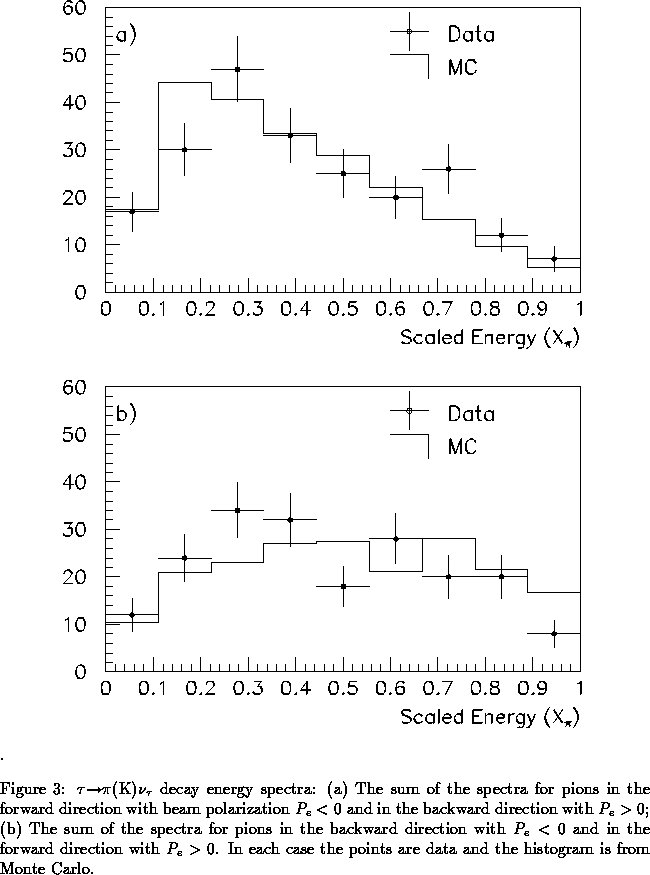
Fig. 3
shows the energy spectrum of
decays for both data and Monte
Carlo, plotted separately for two regions of (
).
Fig. 3(a) shows the spectrum for
and
combined with
and
, while Fig. 3(b)
is for events with
and
together with events with
and
.
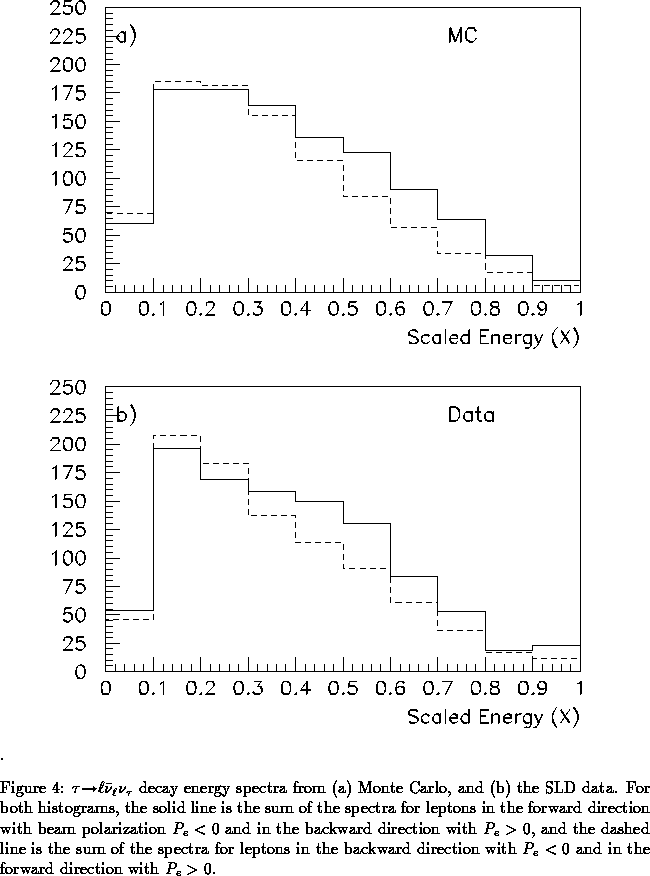
The difference is expected to be less obvious in the three-body decays
, but is still quite visible as shown in Fig. 4.
The tau neutrino helicity, , and the Michel parameters
and
are determined using an unbinned maximum likelihood fit to
the energy spectra of the decay channels
and
. The fit
function is the theoretical differential cross
section (Eq.
) corrected for radiative and detector
effects.
In the maximum likelihood technique, the following expression is minimized:
where is the likelihood function. The sum
in Eq.
runs over all 's that have been identified as
,
or
candidates (
respectively).
The term in the logarithm is the differential cross-section for
production of
-pairs where one
decays into channel
.
This expression is corrected for effects of radiation, detector
resolution, efficiency and backgrounds, and is normalized to unity.
The corrected cross-section can be written in the following form,
Here
is the efficiency for selecting a
-pair event
in which one tau decays via channel
(=e,
,
);
is the efficiency to identify the decay channel
;
corresponds to the distribution of contamination from
misidentified
decays;
and
is the background contribution from events which are
not tau-pairs. These efficiencies and backgrounds were determined from
Monte Carlo by studying the distribution of kinematic variables before
and after event selection. The dependence of these functions on
and
were parameterized using low order polynomials.
The functions are obtained from the theoretical
decay spectra
after applying
radiative corrections and convoluting with the
detector resolution function:
The functions represent the differential
cross-sections
for production of
-pairs with polarized
electrons, corrected for detector resolution and radiative effects:
The ,
represent the detector response functions, i.e.
the distribution of the measured
,
for a given true
,
, respectively.
The radiative correction functions
and
are determined from
the ratio of the spectrum generated using KORALZ [11] for
events containing
radiative effects to the spectrum of events generated with
the Born level cross-sections.
Eq. shows that the statistical
precision in the extraction of the parameter
is not enhanced by the beam polarization, and our systematic uncertainty in its
measurement is relatively large. Since
is well
measured elsewhere [16] [17],
we have fixed its value to a world average.
As
appears in the expression only in the product
, we
fit for
and this product
to reduce errors due to correlations.