


Fitting the sample yields
, which can
be interpreted as twice the helicity of the tau neutrino.
The fit to the
channels gives
and
.
The sources of systematic error which have been considered in the analysis
include -pair selection efficiency and background, decay identification
efficiency and background,
and
resolution, uncertainties in the
measurements of the beam energy and polarization,
uncertainty in the value of
[18],
and the effect of fixing the
parameter.
Table
 summarizes the systematic errors in our
analysis. To investigate these errors, each parameter used in
the fitting program is modified in turn by its uncertainty, and the fit
is redone to obtain new
values of
summarizes the systematic errors in our
analysis. To investigate these errors, each parameter used in
the fitting program is modified in turn by its uncertainty, and the fit
is redone to obtain new
values of ,
and
.
The systematic errors assigned to the effect of fixing
are taken to be the differences from the fitted values of
and
when
is a free parameter.
Any correlation between these input parameters is taken into account
when combining the errors. Each error listed in Table
is a combination of several related contributions,
and for the listed errors we assume they are not correlated.
They are combined in quadrature to give the overall systematic
error listed in the last row of the table.
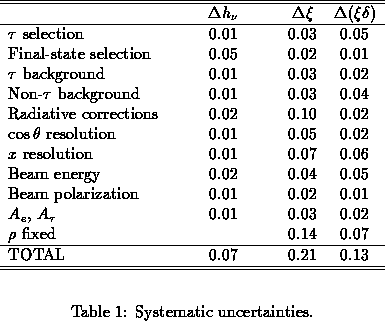
The large uncertainty assigned due to the fixed parameter may be
partly redundant with the systematic error
introduced by the resolution in x. Both of these result from the preliminary
parameterizations of this resolution for the lepton channels, but we have
taken a conservative approach and quoted the errors separately.
Another large contribution to the systematic uncertainty on
is the radiative correction, which affects the electron channel
more strongly. The uncertainty in
is dominated by the
selection efficiency and the interference with the decay channels
N
(
,
, etc...).
Including systematic errors, the SLD preliminary values for
and the Michel
parameters
and
are
The results
are consistent with the Standard Model V-A predictions of -1, 1, .
These measurements
provide an interesting cross check with other experimental
results [16], [17], [19] since
this analysis does not rely on spin correlations and is the first measurement
to be performed with polarized beams. These results demonstrate the power
of polarized beams for probing deviations from the
Standard Model in the weak couplings.