


Selected tau events are divided into hemispheres by the plane normal to the event thrust axis, and the hemispheres are treated independently. Any pairs of oppositely charged tracks which are consistent with originating from a photon conversion are removed, and hemispheres are then required to have only a single track.
For the selection of tau decays to single pions (or kaons), tracks
are required to have no unassociated electromagnetic (EM) LAC energy
clusters within
of the thrust axis. This requirement is powerful for rejecting
backgrounds from decays into
or
.
Electrons and muons are rejected by a series of hybrid cuts applied
with increasing strength, making use of the electromagnetic
and muon calorimeter information. The information used consists of
E/p, hadronic energy, cluster shape, and energy deposited in the WIC.
For the tracks that are left, the associated EM cluster must have fewer than
16 hit towers and the track momentum must be greater than 3 GeV/c.
A further requirement of
is made, and a quasi-invariant mass
is calculated assuming that the associated cluster energy originated
from photons and that
the track is a pion. This quantity is required to be less than
0.3 GeV/c
.
Finally, due to the barrel WIC angular coverage,
the remaining tracks are divided into two regions, namely
and
. The total energy in the
LAC divided by the track momentum is required to be greater than 0.1 in
the former
and 0.3 in the latter case. These criteria discriminate effectively
against muons.
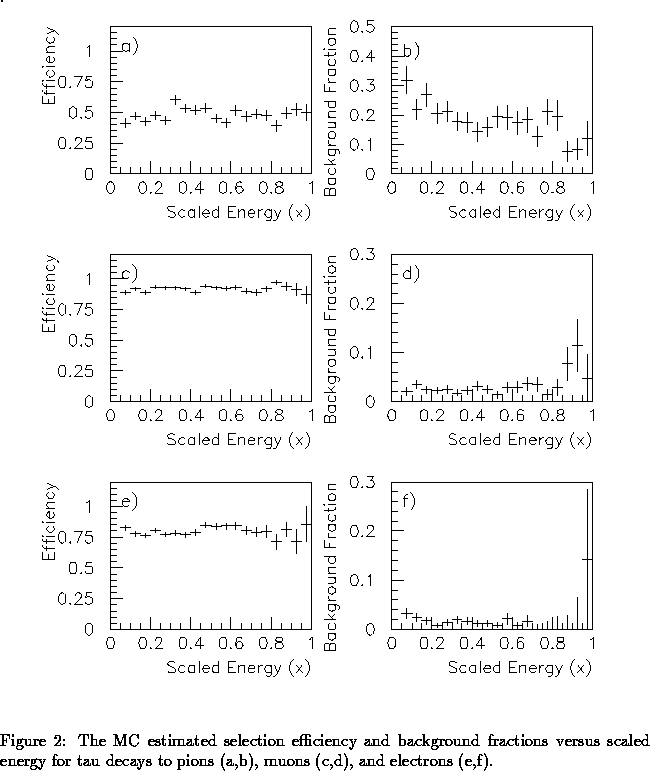
This selection provides a sample of 411 tracks identified as
from the 1993-1995 data,
with an efficiency of approximately 48%and a purity of 84%.
The selection efficiency and background fraction for these decays are
plotted in Fig. 2(a) and 2(b)
as a function of the scaled energy of the track.
For tau decays to muons, the sample is divided into the same polar angle
regions as above. In the region of ,
the WIC is used to identify muons by associating WIC hits with CDC tracks.
In the
region, shower information from
the LAC is used instead. We require that E/p be less than
0.3, that the total number of electromagnetic LAC towers hit in the
associated cluster be less than 4, and that there be no unassociated
neutral clusters within
of the track. In addition, the
quasi-invariant mass (calculated as above) is required to be less than
180 MeV/c
. This results in a sample of 1137 tracks identified as
muons, with an estimated selection efficiency of 92%within the
acceptance, and an estimated purity of 94%.
Fig. 2(c) and 2(d)
show the selection efficiency and background fraction for these tracks.
Criteria for selection of tau decays to electrons are consistent over the full
range . The LAC shower shape must be consistent with
that of an electron, or any valid CRID data must strongly favor the
electron hypothesis over the pion hypothesis.
We require that no energy be deposited in the back
hadronic section of the LAC, and that between 3 and 25 electromagnetic LAC
towers be hit in the associated cluster. In addition, if there are no
unassociated neutral clusters within
of the track, we require that
the quasi-invariant mass be less than 500 MeV/c
.
If there are one or two unassociated clusters within
of the track,
we construct the invariant mass of the cone
assuming the track is a pion and the clusters photons, and require this
quantity to be less than 500 MeV/c
. This results in a sample of 863
identified electron
tracks with an estimated efficiency of 80%within the acceptance and an
estimated purity of 98%. The efficiency and backgrounds versus scaled
energy of these tracks are shown in Fig. 2(e) and 2(f).