

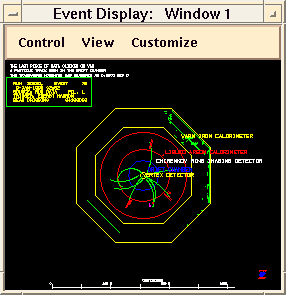
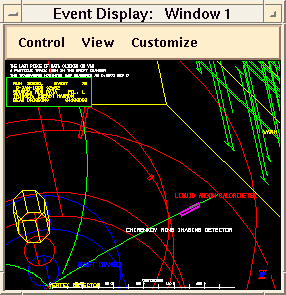

The computer below shows the results of electron-positron collisions as physicists see them in the SLAC Large Detector (SLD).
The immense SLD surrounds the collision point of the Stanford Linear Collider. Data emerges from it through thousands of channels of electronic circuitry, not in any visible form. To "see" what's going on inside the detector, physicists use computer-generated visualizations such as this display.
The pictures you see here represent the most recent Z particle events recorded by the SLD detector.
This is an interactive display. Try it!
To see the most recent event, use the left mouse button to click on the "Control" menu then select "Show Next Physics Event."
Look at the time stamp in the upper left corner of the display to see when this particle event occurred. If the SLD detector is currently taking data, the events you see may be only a few minutes old.

Slider boxes control zoom, rotation and translation. To bring these boxes up, use the left mouse button to click on the "View" menu then select "Zoom...", "Rotate..." or "Translate...".
Now use the left mouse button to click on and drag the slider.
Another way to adjust the display is to click somewhere on the display with the middle mouse button, keep holding the button down, and drag the mouse to a different part of the display. When you release the button the display will focus on the region that you just outlined.
If you see the information box in the upper left corner, but there isn't much else on the screen, it may be that the previous user zoomed all of the interesting parts of the image off the screen. To reset the display, use the left mouse button to click on the "View" menu then select "Reset to Standard View."
To learn more about what you see use the left mouse button to click on parts of the display. The message in the top left corner will then tell you about the object you clicked on.
There are many ways the Z particle can decay. Sometimes the Z will decay into just two particles. Other times, you will see many different particle tracks. Use the "Control" menu's "Show Next Physics Event" button to see different Z particle decays.