Polarization at SLAC Linear Collider

Beam Transport
Two electron bunches are produced from the photocathode gun, which operates
at 120 kV. These electron bunches are injected into the SLAC linac where
they are bunched and accelerated to 1.19 GeV. They are then kicked by a
pulsed magnet into the linac-to-ring (LTR) transfer line to be transported
to the electron damping ring (DR). The DR stores the beam for 8 ms to reduce
the beam emmitance. The ring-to-linac (RTL) transfer line transports the two
bunches from the DR and a pulsed magnet kicks them back into the linac. The
trailing electron bunch is accelerated only to 30 GeV, and is then sent to
the positron production target. Positrons in the energy range 2-20 MeV are
collected, accelerated to 200 MeV, and transported to near the start of the
linac for transport to the position DR, where they are damped for 16 ms. At
the end of the linac, the electron and positron energies are each 46.6 GeV.
A magnet deflects the electron (positron) bunch into the north (south)
collider arc for transport to the interaction point (IP). In the arcs, the
beams lose about 1 GeV in energy from synchrotron radiation so that the
resulting center-of-mass collision energy is 91.2 GeV, which is chosen to
match the Z particle mass. The beam energies are measured with energy
spectrometers to a precision of 20 MeV.
Spin Transport to End of Linac
The electron spin orientation is longitudinal at
the source and remains longitudinal until the
transfer line to the electron DR. In the LTR, the electron spin precesses
by 450 degrees to become transverse at the entrance to the LTR spin rotator
solenoid. This solenoid rotates the electron spin to be vertical in the DR
to preserve the polarization. The spin orientation is vertical upon
extraction from the DR; it remains vertical during injection into the linac
and during acceleration to 46.6 GeV down the linac. The spin transmission
of this system is 0.99, with the small loss resulting from the beam energy
in the DR being 1.19 GeV, slightly lower than the design energy of 1.21 GeV;
this causes the spin precession in the LTR to be 442 degrees rather than
450 degrees, and the spin transmission is the sine of this angle.
End Station A Operation

At the end of the linac the beam can be
deflected with horizontal bend magnets by an angle of 428 mrad into the
ESA beam line. This deflection causes the spin to precess with respect
to the momentum vector. The polarized beam electrons are scattered by
the polarized target and are detected in two spectrometers as shown in
the above figure. The polarized electron beam and polarized nuclear target
can be set up to have their relative spins longitudinally aligned either
parallel or anti-parallel. From the measured cross-section asymmetry for
these two cases, the nucleon spin structure functions can be determined.
The E143
experiment measures the spin structure function for the proton and the
deuteron. The
E154
experiment measures the spin structure function for the neutron.
Arc Spin Rotation
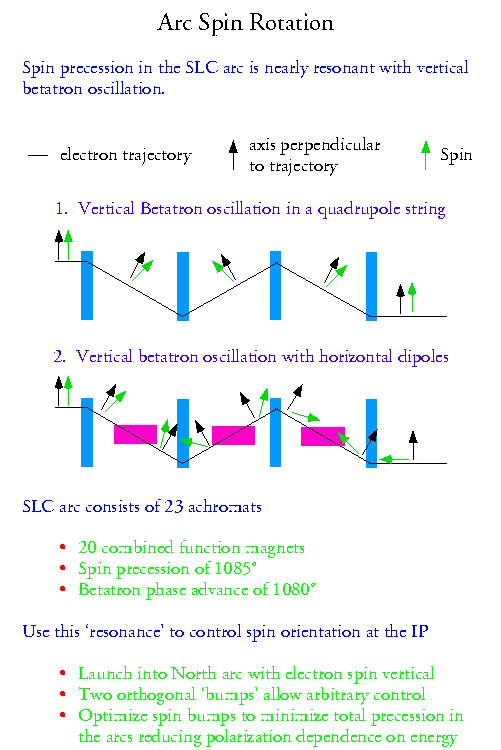
The SLC arc transports the electron beam from the linac to the IP and is
comprised of 23 achromats, each of which consists of 20 combined function
magnets. At 46.6 GeV, the spin precession in each achromat is 1085 degrees,
while the betatron phase advance is 1080 degrees. The SLC arc is therefore
operating near a spin tune resonance. A result of this is that vertical
betatron oscillations in the arc's achromats (combined function magnets
that bend the beam in the horizontal plane), can cause the beam polarization
to rotate away from vertical; this rotation is a cumulative effect in
successive achromats. (The rotation of the vertical spin component in a
given achromat is simply due to the fact that rotations in x
and y do not commute, while the cumulative effect is due to the
spin resonance.) The resulting spin component in the plane of the arc
then precesses significantly.
The arc's spin tune resonance, together with misalignments and complicate
rolls in the arc, result in an inability to predict the spin orientation
at the IP for a given spin orientation at the end of the linac. However,
we have two good experimental techniques for orienting the spin
longitudinally at the IP. First, using the RTL and linac spin rotator
solenoids, one can orient the electron spin to be along the x, y,
or z axis at the end of the linac. The z-component of the
arc's spin transport matrix can then be measured with the Compton
polarimeter, which measures the longitudinal electron polarization.
Once this is determined, the RTL and linac spin rotators are set to
achieve longitudinal polarization at the IP.
A second method to orient the spin longitudinally at the Compton IP takes
advantage of the arc's spin tune resonance. A pair of vertical betatron
oscillations (spin bumps), each spanning seven achromats in the last third
of the arc, are introduced to rotate the spin. The amplitudes of these
spin bumps are empirically adjusted to achieve longitudinal polarization
at the IP. Experiments have verified that the two spin orientation
techniques provide consistent results to a precision of about 1% in the
longitudinal IP polarization. Thus, the two spin bumps can effectively
replace the two spin rotators. This turns out to be very important for
SLC operation, where high luminosity has been achieved by producing and
colliding flat beams. Flat beams are naturally produced in the damping
rings if the x and y betatron tunes are different.
Preserving the flat beams during acceleration and transport to the
IP requires minimizing any x-y coupling in the accelerator.
The coupling introduced by the RTL and linac spin rotator solenoids proves
to be unacceptable. So the problem of the arc spin tune resonance
for modeling the arc spin transport has become a feature that allows
both spin orientation control and flat-beam running for high luminosity.