One way to improve jet energy reconstruction is to recognize that the momentum of charged particles is measured much better in the tracking system than in the calorimeters. Combining this with a measurement of the energy deposited in the calorimeters from neutral particles will then result in superior jet reconstruction. The task is to distinguish between energy deposits in the calorimeters arising from neutral and charged particles. Showers arising from photons will be well localized in the electromagnetic calorimeters and it is assumed here that these showers can be identified with high efficiency and low fake rates. Showers arising from neutral hadrons, on the other hand, are much more difficult to identify. Attempts have been made in the past to reconstruct and identify these showers using only calorimeter information, but the algorithm adopted here uses a combined-detector approach. One assumes a tracker which is able to reconstruct charged particle trajectories with high efficiency and resolution. These tracks are propagated through the calorimeters and the hit cells in the neighborhood of the track intersection are identified. Although hadronic showers are very stochastic, one can characterize the shower shapes both laterally and longitudinally as a function of the incident particle momentum and the number of interaction lengths of material which has been traversed. Using this parameterized shower shape, a likelihood can be assigned to each energy deposition in the calorimeter in the neighborhood of the propagated track. Removing cells associated with identified photons and those with high likelihoods that they resulted from charged hadron showers leaves a much smaller set of hit calorimeter cells to be identified with neutral hadron showers.
The file EnergyFlowRecoDriver.java contains an example of an LCD analysis Driver to which the following analyses can be connected. It can be run within JAS or as a standalone program.
We use the current LCD TrackReco Driver after smearing the ideal Monte Carlo hits with the default SmearDriver. Note that the current hit smearing, pattern recognition and track fitting are only defined for the central regions.
This section to be completed.
The file TrackCellAssociationAnalyzer.java contains example code which accesses the reconstructed tracks in an LCDEvent and propagates each one through the central barrel calorimeters (EM and HAD). (When endcap tracking becomes available, we will extend this to the end calorimeters.) This file only analyzes the energy depositions in the neighborhood of the extrapolated track by filling a histogram. At each layer in the calorimeter, the neighborhood of the track is searched for hit calorimeter cells. The energy of the cell is then added to the appropriate (theta index, phi index) histogram bin. It is intended that this analysis be run over single particle files of fixed input energy, so that the shower shapes can be characterized.
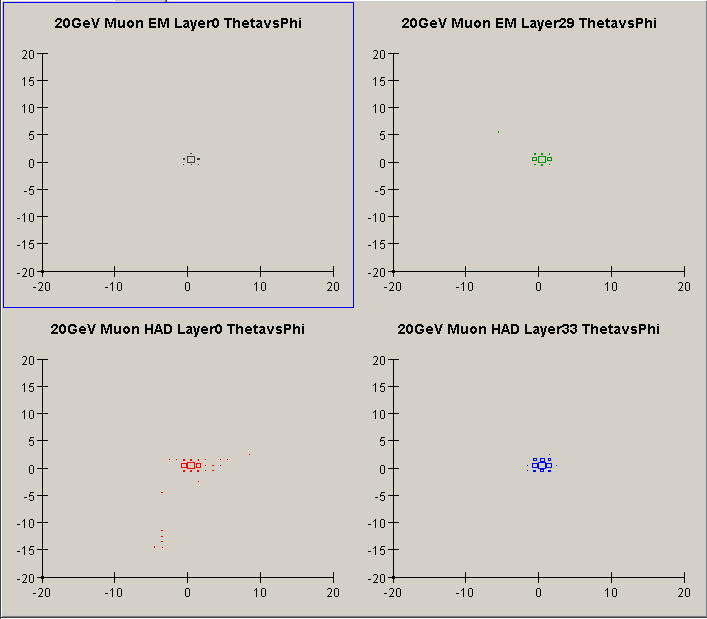
Analyzing single 20GeV muons in the SD detector produces the following
histogram:
It can be seen that the muons deposit energy in essentially one cell per layer and that the track is being correctly propagated through the calorimeter.
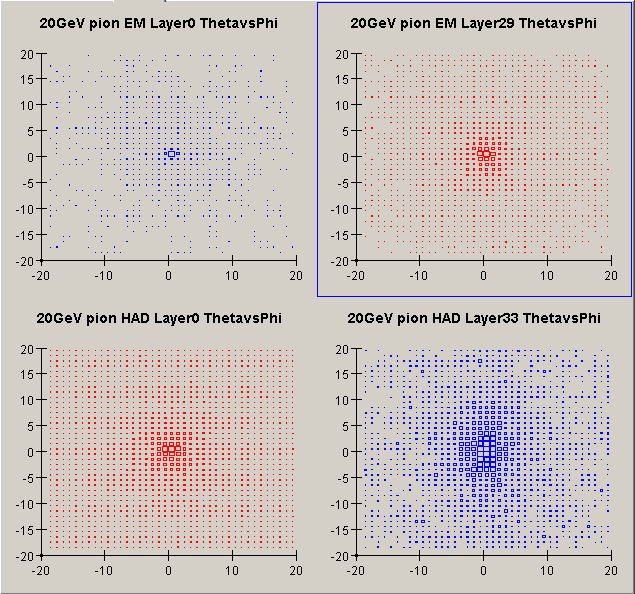
The corresponding plots for single 20GeV pions shows the evolution of the shower transverse size as a function of the calorimeter layer:
A Lego plot of one of the hadronic layers gives a better picture of the
transverse shower shape: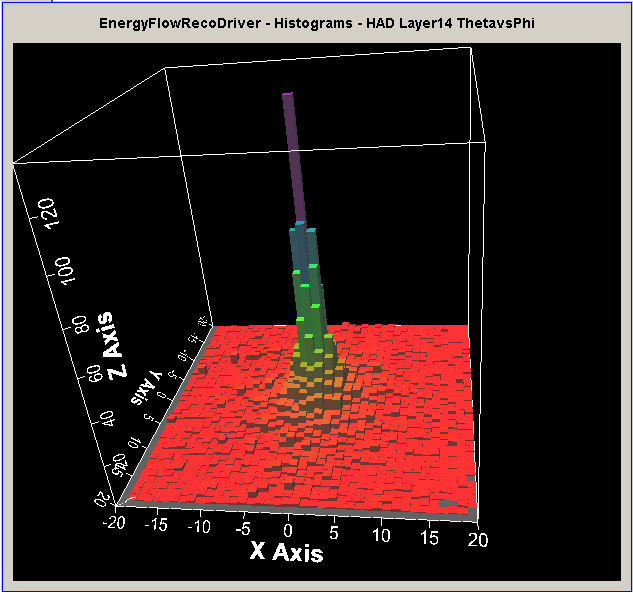
At the end of the job, the histogram contents are fit to a two-dimensional gaussian distribution. (Other functional forms can be investigated in the future.) The rms width of the shower can then be fit as a function of particle energy for each calorimeter layer. An example of how to do this using the JAS Tuple Explorer can be found here. One straightforward refinement of this analysis would be to identify where the shower started, and then histogram the transverse energy deposition as a function of layers traversed since the start of the shower. (The minimum-ionizing deposition prior to the shower will look much like the muon plots shown above.)
This section to be completed.
This section to be completed.
EnergyFlowRecoDriver.java : The LCD Driver for overall analysis control.
TrackCellAssociationAnalyzer.java : Propagates reconstructed tracks through the central barrel calorimeters and fills histograms from which the shower characteriztics can be determined.
LeastSquares2DGaussianFit.java : Simple least squares fitting routine to fit an array of data to a two-dimensional gaussian distribution.