
Discrepancy
in Standard Model Prediction The weak mixing angle can be determined from asymmetry measurements in Z0 interactions with leptons and also from asymmetry measurements in Z0 interactions with quarks. These two techniques give results that differ by 3.5 standard deviations (see summary plot of weak mixing angle results). The reason for this discrepancy could be a statistical fluctuation, an experimental technique problem, or the influence of new physics beyond the Standard Model. The probability for 2
measurements to disagree by 3.5 standard deviations (3.5s) is
much less than 0.1%. This means that in a sample of 1000 measurements, it is
unlikely for any 2 of
the 1000 measurements to disagree by 3.5s or more.
And for any random
comparison of 2 measurements, it is highly unlikely to observe such a large disagreement. |
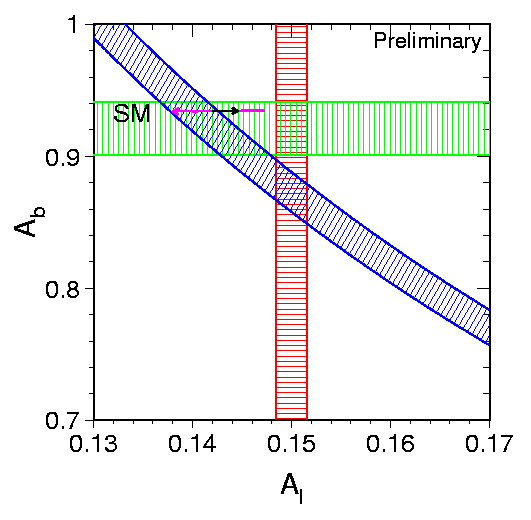 |
| SLAC and CERN results for asymmetry
measurements in the interactions of Z0 particles with b-quarks and
leptons. The SLAC and CERN measurements for the leptonic asymmetries, Al,
are combined and are represented by the red band. SLD measures the b-quark asymmetry
parameter, Ab, directly (because of its polarized electron beam) and this
result is shown as the green band. The CERN experiments measure a forward-backward
asymmetry in Z0 decays to b-quark pairs and this asymmetry is proportional to
the product of Ab times Al. This CERN result is shown as the
blue band. The Standard Model predicts that Ab should be equal to 0.935,
and that Al should be in the range from 0.136 (for a Higgs mass of 1000 GeV) to
0.147 (for a Higgs mass of 113 GeV). The widths of the bands shown represent +/- 1
standard deviation. SLAC and CERN's Al results favor a light (Standard Model) Higgs and SLD's Ab result is consistent with the Standard Model prediction. CERN's forward-backward b-quark asymmetry result favors a heavy (Standard Model) Higgs. The self-consistency of these three data measurements and the Standard Model predictions is marginal and has only an 0.2% probability to give the large observed c2/dof=12.4/2. Of the three data measurements, the simplest and most reliable one experimentally is the Al result. In particular, SLD's very precise measurement of Al from its left-right asymmetry (ALR) measurement results from a simple counting measurement and is very robust. |
Last updated 04-09-2001